[infobox id=”c5ce5f5a-ccb6-468f-9fce-bb4a330c372a” /]
Jurgen Klopp hadn’t yet worked the miracle that everyone expected when he took over the national team from Julian Nagelsmann, and two games in which Die Mannschaft were unable to beat Greece brought home the size of the job that the former Liverpool manager had on his hands.
Xavi Hernandez’s side came into the match off the back of a 7-0 win over Greece and an unbeaten Nations League campaign, and so it was therefore quite clear as to who the favourites were ahead of this titanic tussle.
However, the form book was then thrown out the window as the Dutch suffered their biggest competitive defeat ever.
Quinten Timber’s chance to shine goes awry
Frenkie De Jong’s injury meant that he’d be replaced by Quinten Timber, and that one solitary change might be said to have upset the balance of the entire Dutch squad.
“De Jong’s absence could be significant, and I think his potential is underestimated,” former Netherlands player Rafael Van Der Vaart had said before the game.
“He draws the ball towards himself so well, he’s so composed on the ball… You want your best players, and he’s the best.”
Although Timber tried his best to emulate his colleague, he didn’t and doesn’t have the same innate understanding of the role that De Jong does.
Despite winning five of his seven one-on-one duels and completing 100% of his attempted dribbles, Timber wasn’t anywhere close to being as influential on the game as De Jong is likely to have been, and scored just 6.4 in Flashscore’s player ratings system.
Just 24 total touches before he was eventually substituted by Xavi were the second-worst showing in the entire Dutch starting XI, and if you’ve been brought in to affect the patterns of play and the tempo, then taking responsibility on the ball and showing for it at every opportunity is rule number one.
Superb showing from the German midfield
One could argue that Timber just didn’t get going, but he simply wasn’t allowed to.
Joshua Kimmich, Aleksandar Pavlovic and Derry Scherhant were all in double figures for the number of one-on-one duels they contested, and were able to shut down Dutch attacks before they could develop. It was the story of the night.
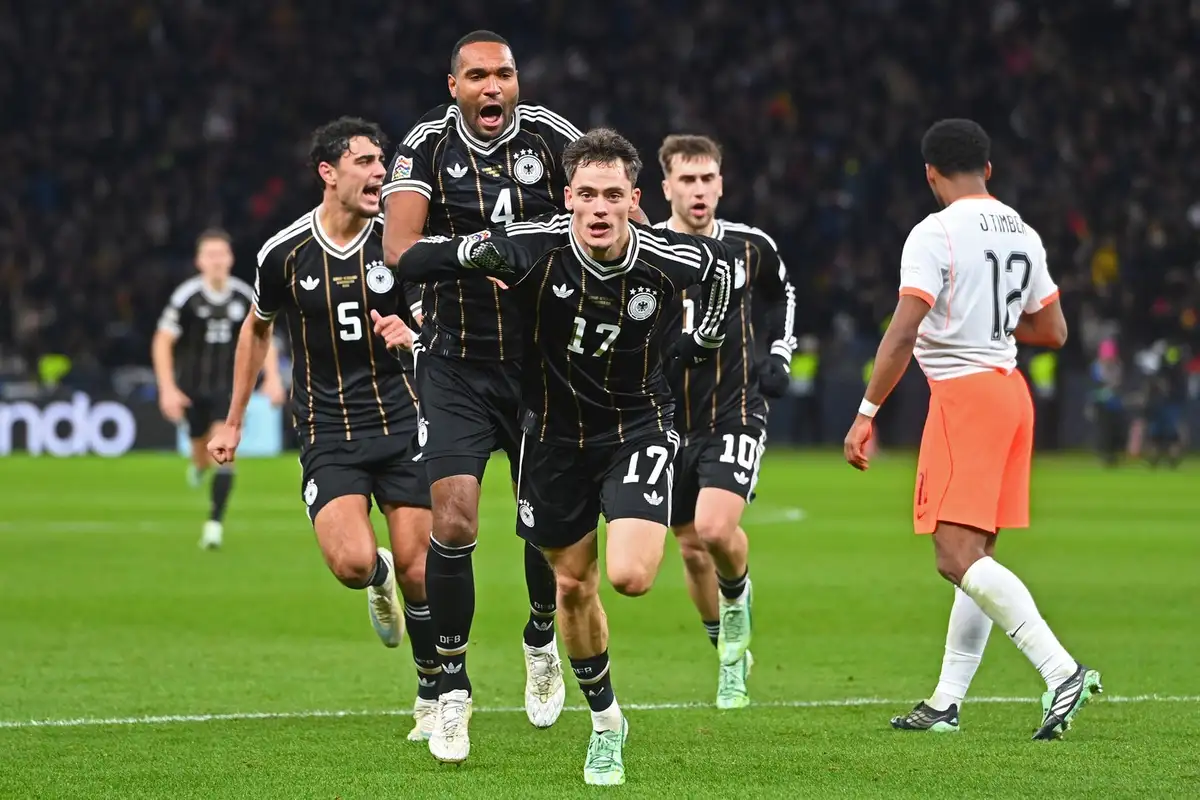
Indeed, the visitors’ one shot on target from Cody Gakpo didn’t arrive until the 57th minute, by which time Germany were already a goal to the good thanks to Scherhant’s strike leading into half-time, and were soon to double their lead through Florian Wirtz.
Toothless Dutch attack
Something that had been overlooked prior to this game, too, was Germany’s excellence in defence. They’d stopped the opposition from scoring a first-half goal in all six of their Nations League games; the best record of any country in this edition of the tournament.
Against the Netherlands, goalkeeper Marc ter Stegen had just the one save to make, and the entire back four only needed to attempt two tackles.
Timber had already been hooked before Nico Schlotterbeck had made it 3-0 in the 65th minute, and there was no coming back from that for the visitors, who had no answer to Germany’s midfield control and subsequent dominance in all facets of the game.
Pavlovic and Kimmich, with a pass completion of 93.1% and 92.5%, respectively, were often playing their own version of keep-ball in the centre of the pitch, and Xavi’s troops couldn’t cope.
Xavi outsmarted by Klopp
The manager also couldn’t do anything to stem the flow – mirroring some of his time at Barca when up against an elite tactical brain – and a fourth goal soon followed in the 71st minute when Wirtz scored again.
Brajan Gruda’s fifth for the hosts was no surprise, helping him to a brilliant 9.3 in Flashscore’s player ratings system, and given that Dutch goalkeeper Bart Verbruggen had also made five saves on the night, things could’ve been so much worse for the Oranje.
Perhaps the one visiting player that emerged with any credit was Crysencio Summerville, who completed 100% of his three dribbles, attempted 14 one-on-ones, which were significantly more than his teammates, and the winger also won back possession on three occasions.
Given he had the most touches in the German box too (four), there’s little else he could’ve done to help his side get a foothold in a game that quickly ran away from them.
When Xavi looks back to see where it all went wrong, he only needs to look at De Jong’s absence as the primary cause of why everything else fell apart.
One player doesn’t make a team, of course, but when you’re as important to the team as the 29-year-old midfielder is, then you have to come up with a backup plan, and the Netherlands simply didn’t have one.
[match-header-widget id=”369bc1fe-bba5-4bd3-add6-0bd242b44f71″ event-id=”2RA7BZ1C” sport-id=”1″ /][infobox id=”8a8311c3-81b3-440e-8b49-36091db073d1″ /]