The prospects had their latest basketball season, and the NBA draft combine to solidify their worth and strengths. Remaining in the first round is crucial – the first thirty picks will receive a predetermined, guaranteed multi-year contracts based on the rookie scale. The second-round picks will get nonguaranteed contracts, meaning they will negotiate their salaries with their teams.
While not an official rule, the financial investment tied to first-round picks means they almost always make the 15-man roster. That provides an opportunity to earn minutes early, learn from established veterans, and develop at the highest level.
In the final installment of our draft series, we predict which prospects will hear their names called in the first round and secure the benefits that come with being a top-30 selection. And even late first-rounders or second-round picks can transform into MVP-caliber playmakers.
25. Lakers – Chris Cenac Jr. (PF/C, Houston)
Cenac had one of the most successful performances at the NBA draft combine, significantly raising his stock and strengthening his position in the first round.
He measured well and stood out during the scrimmage and on-court drills because of his high motor, physicality, and strength. For a player his size, Cenac possesses excellent speed and mobility, traits that should help him thrive in today’s fast-paced NBA.
Los Angeles need help in the frontcourt, and Cenac could be a great investment for the future. The Houston standout rebounds with tenacity and protects the rim well. His athleticism allows him to play at the four, but he could also excel at the five.
He averaged 9.5 points and 7.9 rebounds for the Cougars, and the center is also capable of shooting from deep, even though the mid-range jumper is where his confidence lies. Houston’s system asked him to play conservatively, but with more freedom at the next level, Cenac has the tools to develop into a high-level rim protector and floor-spacing big man.
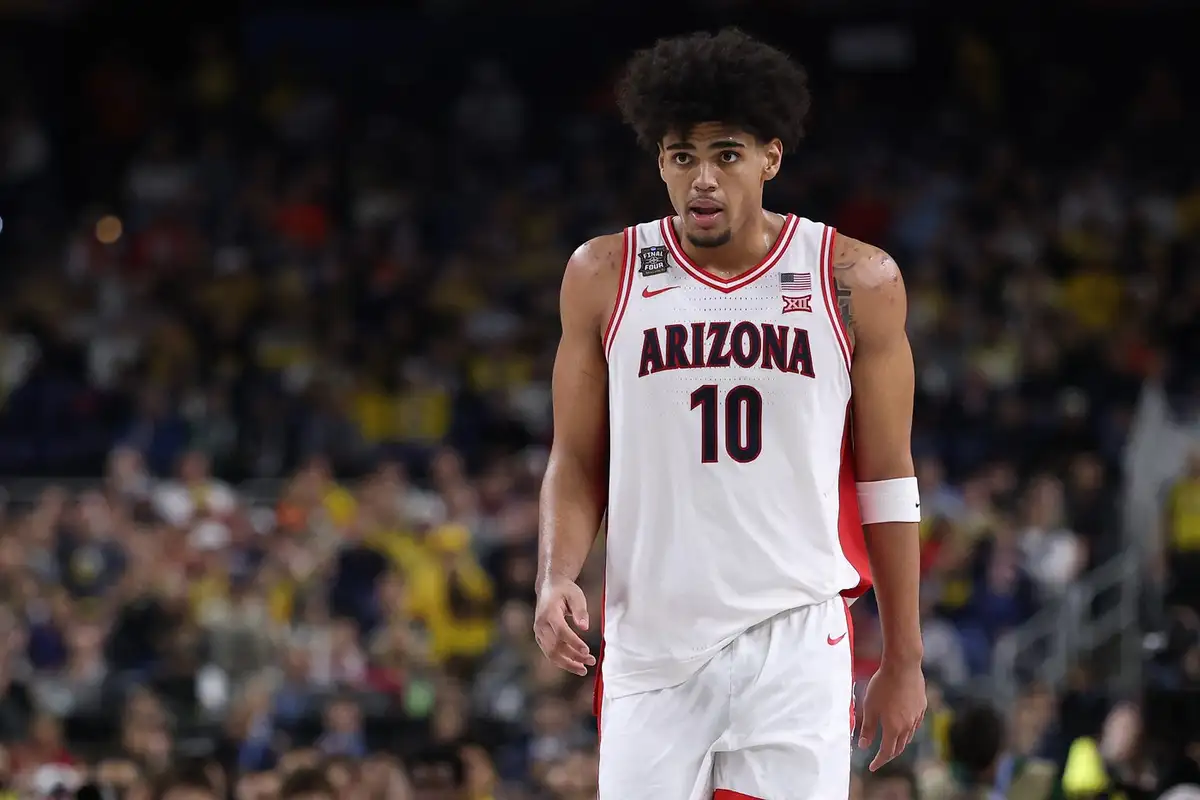
26. Nuggets – Koa Peat (F, Arizona)
The Denver Nuggets need to strengthen the presence around Nikola Jokic. Adding a big in this class would be huge, and Koa Peat fits Denver’s style – he can score from both the inside and the outside, and he attacks the glass with purpose.
He recorded 14.1 points, 5.6 rebounds, and 2.6 assists per game at Arizona and helped the Wildcats advance to the Final Four. Peat is athletic and mobile and would be a great option for small ball. One of his biggest strengths is defense.
His athleticism allows him to contain his opponents, and he also doesn’t shy away from contact, something the Nuggets desperately need when Jokic is on the bench.
The main question is his shot.
His shooting mechanics sparked debates at the combine – he has a unique technique and isn’t reliable from distance just yet. He shot 35% from beyond the arc, but only 5% of all his shots came from downtown.
The majority of his two-pointers came off the dribble, meaning he isn’t a catch-and-shoot threat. However, as a big, he gets some grace regarding his shooting and will have time to develop and improve before his debut NBA season.
27. Celtics – Alex Karaban (F, UConn)
Karaban spent four years at UConn, winning back-to-back national championships and establishing himself as one of the program’s foundational pieces. Initially projected as a second-round prospect, his impressive senior season elevated his stock and demonstrated that he could contribute immediately at the professional level.
He averaged 13.2 points, 5.3 rebounds, and 2.4 assists while helping guide the Huskies to another NCAA title game. Karaban shot 46.4% from the field and 37.4% from deep, averaging almost two triples per game.
His shooting ability should appeal to the Boston Celtics, whose system would maximize his strengths. Karaban thrives in catch-and-shoot situations but is also capable of creating enough space to score off the dribble.
At 6-foot-8, he can punish smaller defenders in the post and contribute across multiple positions. A natural comparison is Sam Hauser, who developed into a reliable rotation player and occasional starter.
Karaban could follow a similar path.
28. Timberwolves – Isaiah Evans (G, Duke)
There is no doubt the Minnesota Timberwolves need more talent in the backcourt to make a deep playoff run. And while a late first-draft pick will most likely not solve all of their issues, a skilled and proven scorer could provide a much-needed boost.
Evans fits that mold – he is a savvy cutter, catch-and-shoot machine, and reliable creator and facilitator. He spaces the floor well, making defenders choose between helping and staying with him.
Evans entered the draft last year but decided to withdraw and spend another year developing his game at the collegiate level. This choice proved critical, as Evans matured and raised his confidence.
He went from 6.8 points per game as a freshman to 15 points per contest as a sophomore. With ideal size for a wing and the versatility to contribute in multiple roles, Evans could compete for rotation minutes from day one.
29. Cavaliers – Karim Lopez (PF, New Zealand)
The Mexico native spent the latest season competing in New Zealand, already gaining some experience at the pro level. At 6-foot-8 and 221 pounds, Lopez showcased above-average athleticism and speed.
He is dynamic and tough to stop when attacking downhill. The power forward spaces the floor well, reads his teammates, and cuts with purpose. Thanks to great footwork and agility, he moves well, allowing him to switch on guards to contain them and contest their shots.
The Cleveland Cavaliers significantly improved after trading for James Harden. Now, it’s time to better the frontcourt.
Lopez’s skill set sets him up for success, but he will have to earn the trust of the franchise. His shooting percentages weren’t the greatest, but he makes up for it by securing rebounds, making good reads, and playing solid defense.
The experience in the NBL should ease his transition to the NBA.
30. Mavericks – Meleek Thomas (G, Arkansas)
After drafting the rookie of the year in Cooper Flagg a year ago, the Dallas Mavericks want to keep deepening their roster with youth talent instantly available to improve the team’s performance.
Thomas posted a notable freshman campaign at Arkansas, averaging 15.6 points, 3.8 rebounds, and 2.5 assists. Under legendary coach John Calipari, Thomas developed into a fearless scorer.
He never hesitates to shoot, capitalizes on catch-and-shoot situations, and consistently pressures defenses by attacking the rim. His floater became one of the most effective weapons in college basketball.
Thomas is an all-around scorer. He shot the three at 41.6% and also added 1.5 steals per game. The Mavericks could make him the last first-round pick and give him a chance to make a notable impact. The guard reads pick and rolls well but needs to improve his passing game.
However, having Flagg and the Mavericks’ ninth pick by his side, finding open teammates should get easier.
The only factor that hurts his profile is his size, as he is 6-foot-3 barefoot.

Other articles
-

Football
/ 6 hours agoFormer Man Utd defender Tyrell Malacia signs for MLS side FC Cincinnati
Malacia, 27, has signed a one-year contract with the Ohio club. “We are excited...
By admin -


Tennis
/ 8 hours agoBulgaria off to great start in Denmark as Dimitrov wins first Davis Cup match in 11 years
Denmark trails 0-1 after the first match of the Davis Cup tie against Bulgaria...
By admin -

Basketball
/ 8 hours agoClippers and Raptors reach agreement for Kawhi Leonard’s return to Toronto
The two teams, reportedly close to sealing the deal according to the media, had...
By admin -

Football
/ 8 hours agoGhana international Alidu Seidu joins Nice on season-long loan from Rennes
The 26-year-old completed his move to Nice on Friday, September 18, and will remain...
By admin